Embroidery for the Screen
I don’t think I’ve ever really mentioned this before, but the original piece was a fire screen with an embroidered panel. I can no longer remember where I first came across it, and I no longer have any photographs of the original piece—only the image of the embroidery itself. So at the moment, I have absolutely no idea what kind of setting or frame to create for it. I could use metal, wood, carving, marquetry, painted decoration—almost anything. In short, I have plenty to ponder during the long evenings ahead.

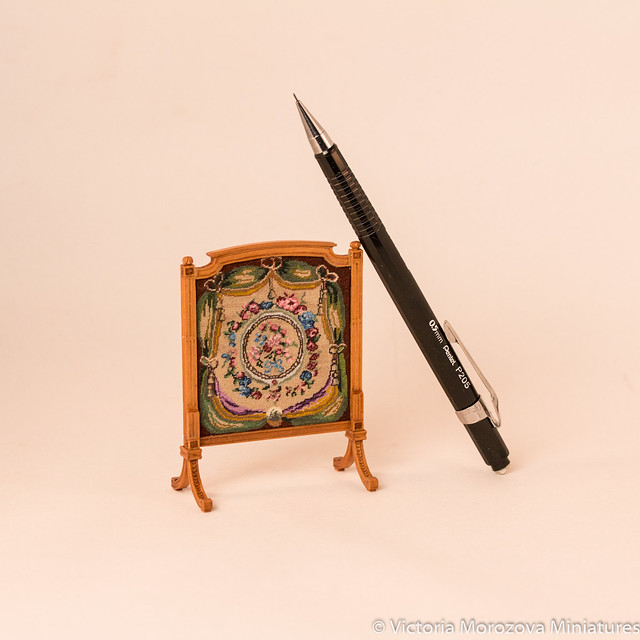
What you see in the photo is the result of 76 hours of work. The embroidery is worked on 90-count canvas, which means 90 stitches to the inch. So far, I have completed about 19,960 stitches, while the entire piece will require a little over 43,000. That puts me at 46%.What you see in the photo is the result of 76 hours spent. Embroidery on 90-count canvas, which means 90 stitches per inch. Right now about 19,960 stitches are done, and in total I need to make about 43 thousand and change stitches. In other words, 46% is already finished.
Over the summer, I had a mild bout of panic. You sit at the table for three hours, yet the number of stitches remaining barely seems to change, and there is almost no visible progress. It is incredibly demotivating and frustrating. All you can do is keep going and remind yourself that it only feels this difficult while you are in the middle of it; later, you will look back and smile.
And now it really is getting easier. Almost half the work is behind me, and I already want to make a matching screen—which is an utterly ridiculous idea, because that would mean another 43,000 stitches! Once again, there would be the agony of trying to choose the right colors: making a start, discarding it, and repeating the whole cycle all over again. Then again, perhaps experience will finally make itself useful, and the second screen will be much easier.
All that remains is to find the right subject. Once again, I want something very sweet and floral. We’ll see.
Miniature Embroidery in 1:12 Scale: Why It Takes So Long
Let’s talk about miniature embroidery.

I recorded a dedicated video on this subject about three years ago. If you watch it, you’ll also see the embroidered upholstery panels for the armchairs I showed yesterday (around 2:13). I briefly explain my choice of threads and needles there, so I won’t repeat all of that here.
Instead, I’d like to add a few things I’ve learned since then.
The first—and perhaps most important—is this:
Embroidery in 1:12 scale is slow. Very slow.
Choosing the Fabric
Let’s start with the foundation.
We don’t use the standard embroidery canvas you’ll find in most craft stores. Instead, we use silk gauze—sometimes sold as silk organza because it is transparent and fairly stiff.
However, ordinary silk organza from a fabric shop usually isn’t suitable for counted embroidery. What we need is an even weave, where every thread is perfectly spaced to create a regular grid.
People often ask whether another evenly woven fabric could work instead.
Personally, I think the answer is yes—but with one important condition.
Try to find something softer and more flexible than traditional silk gauze.
The stiffness of silk gauze is actually an advantage for flat pieces such as fire screens or decorative panels. Upholstered furniture is another story. When covering miniature chairs or sofas, a rigid foundation easily develops unwanted folds and creases. Even silk gauze can be difficult to shape, so choosing the right fabric is worth the effort.
What Count Do Miniaturists Use?
Most miniature embroiderers try not to go below 40-count silk gauze (40 holes per inch). For miniature carpets, for example, 40-count is fairly standard and offers a good balance between detail and the time required to complete a project.
There is also the Miniature Needlework Society in the UK, which brings together enthusiasts of miniature embroidery, knitting, and bobbin lace. I’m not a member myself, but I’ve heard from fellow miniaturists that they generally recognize work stitched on 72-count silk gauze or finer. I can’t personally verify that, though!
That said, I have to admit that embroidery on 72-count—or even 90-count—looks absolutely incredible.
The frustrating part is that photographs don’t really capture the difference. At miniature shows and exhibitions I always found myself staring at embroidered pieces because they’re simply breathtaking in person. In many cases it doesn’t even look like embroidery anymore. It looks like a woven textile made specifically for the furniture.
I’ve seen some outstanding painted upholstery in miniature, and when it’s done in scale it can be wonderfully convincing. But exceptional embroidery has a unique richness that is difficult to imitate. It’s also one of the reasons why furniture upholstered with miniature embroidery is usually far more expensive than painted upholstery.
That doesn’t mean painted upholstery is somehow inferior. Not at all. If it’s executed with the right level of detail and looks convincing in scale, it’s an excellent solution.
Designing the Pattern
In the video I mentioned that I create my embroidery charts digitally.
The programs I use are PC Stitch and WinStitch.
Of the two, WinStitch isn’t my favorite. Large charts can become painfully slow, especially when using operations such as mirroring or cropping.
Today I would add another essential stage to the process: sketching.
I used to make detailed sketches only for marquetry or painted decoration, but once you start working on 60-count silk gauze or finer, preliminary sketches and color studies save an enormous amount of time.
As I mentioned in the video, I always stitch a small test section before committing to the final embroidery. It’s the only reliable way to evaluate color combinations. I wouldn’t skip that step.
And, of course, having a large selection of threads helps enormously.
That’s one of the reasons I still love Chinese silk. It comes in an astonishing range of colors, and when I bought most of mine, it was surprisingly affordable.
Magnification
People often ask what magnification I use.
Most of the time I work with binocular magnifiers.
Recently, however, I discovered something rather amusing.
When stitching on 72-count silk gauze, I don’t actually need magnification at all. I’m quite nearsighted, so before I start stitching, I simply take my contact lenses out.
It works surprisingly well.
I haven’t tried the same trick on 90-count yet—mostly because I need to finish my current project first.
Why It Takes So Long
At the beginning of this article I said that miniature embroidery is slow.
I wasn’t exaggerating.
A single small flower stitched on 72-count silk gauze takes me at least 30 minutes. That’s only about 100 stitches.
Those stitches may involve four or five different shades, which means constantly changing threads, separating individual silk strands, preparing them, and occasionally adjusting the colors as the work progresses.
Interestingly, higher counts make color transitions more subtle, so achieving enough contrast often requires changing the original plan.
Background areas are much faster than floral motifs—but they’re still time-consuming.
Now imagine an embroidery measuring 190 × 190 stitches, and you’ll have a pretty good idea of why these projects take so many hours.
Why I Prefer Fine Counts
So why do I choose such fine silk gauze?
Simply because I love the result.
Higher counts allow for significantly more detail, more sophisticated chart design, and a much more convincing textile effect.
After years of working this way, I’ve also developed a good intuition for matching thread thickness to the fabric, which makes the entire process much more enjoyable.
It’s certainly not the fastest way to embroider miniature upholstery—but for me, the finished result is worth every stitch.
Chippendale Armchairs
Armchair set, finally ready!


In 2018, an exhibition of Thomas Chippendale’s furniture was held in Leeds (I hope I haven’t bored you yet by mentioning this name here and there). Every exhibition usually comes with its own catalog. And I usually buy these. So, in this catalog, there was a wonderful screen that I had already managed to make and sell, and there was also a wonderful armchair with tapestry upholstery. I searched the internet, found a few more not-so-great photos, and decided to tackle a set of two armchairs.
For those who missed it and haven’t read previous posts, let me remind you that this is already the third pair of armchairs. The first two ended up in the trash: the first for its carving and design, the second for its clumsy gilding.

With the current armchairs, everything seems to be fine. I really like the gilding now, the upholstery didn’t cause trouble, and the casters were relatively easy to make, although I did manage to break several 0.5mm drill bits. But these are just part of the process, and I really need to get to the lathe more often and make something else.

And, perhaps, in the next post, I will talk about some nuances of embroidery at this scale.
Французский игровой столик – закончен.
The project I needed to finish two years ago. A French Game Table, the first one went to the auction at IGMA school. I was going to make two of them actually, but I didn’t have enough time to finish it. Besides, I realized that I needed to improve the overall design of the brass mounts, my porcelain painting skills needed an upgrade as well. The inside mount is designed and stitched by me on a 72 count silk gauze. The insert of such a complex form made me cry several times while mounting it, I’m still not very happy about it, but here it is. Sometimes I felt overwhelmed with the whole thing to be honest. I’m happy it’s done. Time to turn the page and move on.


Petit point and a drawing
I’m busy making a new drawing for a French game table top, the inside part of it. Petit point insert is mounted on a cardboard already, the inside part was finished too, but I looked at it couple days ago and didn’t like it. I wanted to add some details, maybe change a color palette as well.
I really like this new version, I think I’ll use pear wood for the background, something bright like maple or birch for decoration and makore wood for the outside border.
Meanwhile, the porcelain plaques are finished, at least I think they are for now 🙂 But I don’t have the photos yet, stay tuned.

Chippendale Firescreen
After pretty successful experience with higher count petit point, I decided that I can make another screen, but this time on 90 count silk gauze. I found this screen in a book dedicated to Thomas Chippendale 300th anniversary of birth. It’s pretty tall 169.5cm high, the screen itself is pretty large too.
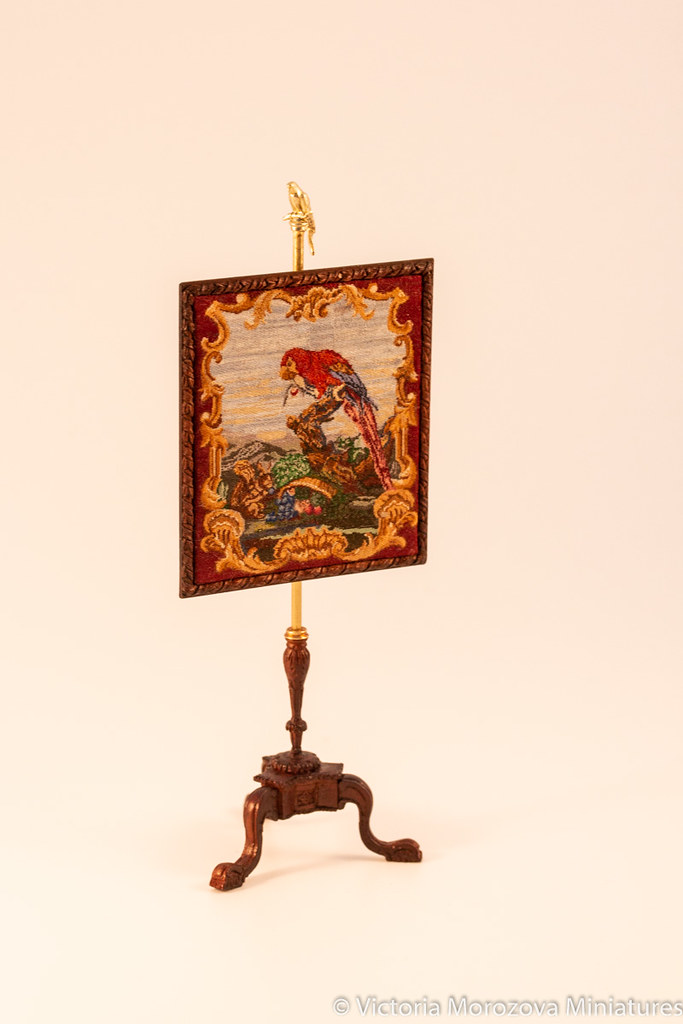
I should also say that the original screen is fully made of wood, in my version a pole and a finial are made of brass. The finial was traditional too, but I made a parrot 🙂
The screen is stitched on a 90 count silk gauze, with Chinese silk floss.


French Firescreen, the second version.
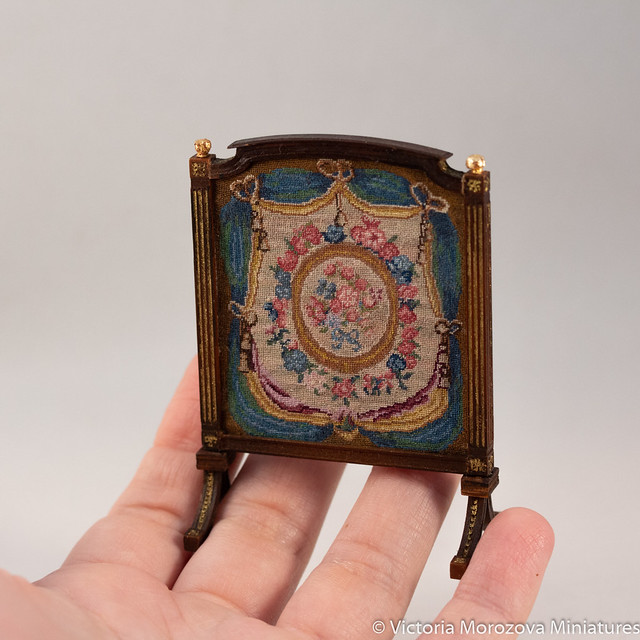
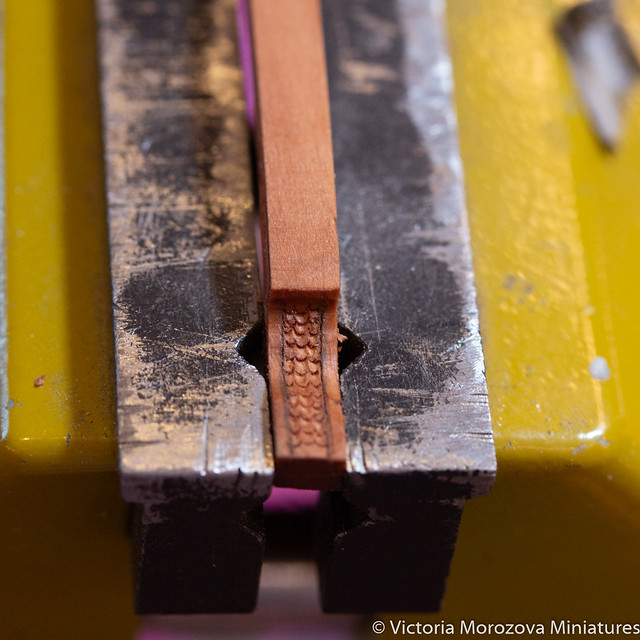
I don’t really understand how I missed that one on my blog, I took it to IGMA school last year and haven’t posted about it! This screen is a bit different, it has a higher count silk gauze (86) and different design, besides the frame has a different finish.
A bit of a process:
Petit point
I caught a cold, so last week was out. I only managed to finish one item in Solidworks, pretty happy about it.
Among other good things – finished petit point “something”. I have no idea what I’d make with it, pillow or something for furniture, I started stitching another thing so later we’ll see and decide.
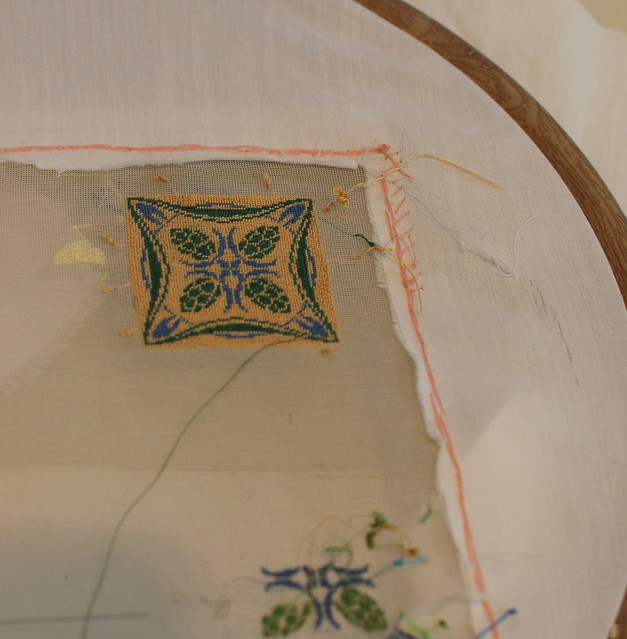
It’s 72 count silk gauze, Russian silk.
Dollshouse from Kensington Palace
This time I had to make a break, I have a terrible luck with nannies. I’m hoping to get one next week, but for now I’m super jealous of those lucky girls who have grannies 🙂 My kid just turned one last week and I’m not getting younger, the good thing about birthdays – I got a superb present from my husband, Proxxon planer. I had no time to test it properly, so I’ll leave it for now till the next post.
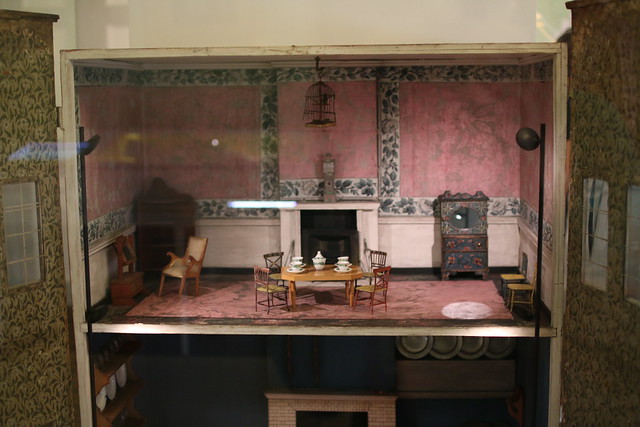
Now for some photos from London, this time – from Kensington palace and V&A museum, this one is a dollhouse which was made for Queen Victoria: