

Miniature Embroidery in 1:12 Scale: Why It Takes So Long
Let’s talk about miniature embroidery.

I recorded a dedicated video on this subject about three years ago. If you watch it, you’ll also see the embroidered upholstery panels for the armchairs I showed yesterday (around 2:13). I briefly explain my choice of threads and needles there, so I won’t repeat all of that here.
Instead, I’d like to add a few things I’ve learned since then.
The first—and perhaps most important—is this:
Embroidery in 1:12 scale is slow. Very slow.
Choosing the Fabric
Let’s start with the foundation.
We don’t use the standard embroidery canvas you’ll find in most craft stores. Instead, we use silk gauze—sometimes sold as silk organza because it is transparent and fairly stiff.
However, ordinary silk organza from a fabric shop usually isn’t suitable for counted embroidery. What we need is an even weave, where every thread is perfectly spaced to create a regular grid.
People often ask whether another evenly woven fabric could work instead.
Personally, I think the answer is yes—but with one important condition.
Try to find something softer and more flexible than traditional silk gauze.
The stiffness of silk gauze is actually an advantage for flat pieces such as fire screens or decorative panels. Upholstered furniture is another story. When covering miniature chairs or sofas, a rigid foundation easily develops unwanted folds and creases. Even silk gauze can be difficult to shape, so choosing the right fabric is worth the effort.
What Count Do Miniaturists Use?
Most miniature embroiderers try not to go below 40-count silk gauze (40 holes per inch). For miniature carpets, for example, 40-count is fairly standard and offers a good balance between detail and the time required to complete a project.
There is also the Miniature Needlework Society in the UK, which brings together enthusiasts of miniature embroidery, knitting, and bobbin lace. I’m not a member myself, but I’ve heard from fellow miniaturists that they generally recognize work stitched on 72-count silk gauze or finer. I can’t personally verify that, though!
That said, I have to admit that embroidery on 72-count—or even 90-count—looks absolutely incredible.
The frustrating part is that photographs don’t really capture the difference. At miniature shows and exhibitions I always found myself staring at embroidered pieces because they’re simply breathtaking in person. In many cases it doesn’t even look like embroidery anymore. It looks like a woven textile made specifically for the furniture.
I’ve seen some outstanding painted upholstery in miniature, and when it’s done in scale it can be wonderfully convincing. But exceptional embroidery has a unique richness that is difficult to imitate. It’s also one of the reasons why furniture upholstered with miniature embroidery is usually far more expensive than painted upholstery.
That doesn’t mean painted upholstery is somehow inferior. Not at all. If it’s executed with the right level of detail and looks convincing in scale, it’s an excellent solution.
Designing the Pattern
In the video I mentioned that I create my embroidery charts digitally.
The programs I use are PC Stitch and WinStitch.
Of the two, WinStitch isn’t my favorite. Large charts can become painfully slow, especially when using operations such as mirroring or cropping.
Today I would add another essential stage to the process: sketching.
I used to make detailed sketches only for marquetry or painted decoration, but once you start working on 60-count silk gauze or finer, preliminary sketches and color studies save an enormous amount of time.
As I mentioned in the video, I always stitch a small test section before committing to the final embroidery. It’s the only reliable way to evaluate color combinations. I wouldn’t skip that step.
And, of course, having a large selection of threads helps enormously.
That’s one of the reasons I still love Chinese silk. It comes in an astonishing range of colors, and when I bought most of mine, it was surprisingly affordable.
Magnification
People often ask what magnification I use.
Most of the time I work with binocular magnifiers.
Recently, however, I discovered something rather amusing.
When stitching on 72-count silk gauze, I don’t actually need magnification at all. I’m quite nearsighted, so before I start stitching, I simply take my contact lenses out.
It works surprisingly well.
I haven’t tried the same trick on 90-count yet—mostly because I need to finish my current project first.
Why It Takes So Long
At the beginning of this article I said that miniature embroidery is slow.
I wasn’t exaggerating.
A single small flower stitched on 72-count silk gauze takes me at least 30 minutes. That’s only about 100 stitches.
Those stitches may involve four or five different shades, which means constantly changing threads, separating individual silk strands, preparing them, and occasionally adjusting the colors as the work progresses.
Interestingly, higher counts make color transitions more subtle, so achieving enough contrast often requires changing the original plan.
Background areas are much faster than floral motifs—but they’re still time-consuming.
Now imagine an embroidery measuring 190 × 190 stitches, and you’ll have a pretty good idea of why these projects take so many hours.
Why I Prefer Fine Counts
So why do I choose such fine silk gauze?
Simply because I love the result.
Higher counts allow for significantly more detail, more sophisticated chart design, and a much more convincing textile effect.
After years of working this way, I’ve also developed a good intuition for matching thread thickness to the fabric, which makes the entire process much more enjoyable.
It’s certainly not the fastest way to embroider miniature upholstery—but for me, the finished result is worth every stitch.
IGMA School. Часть вторая.
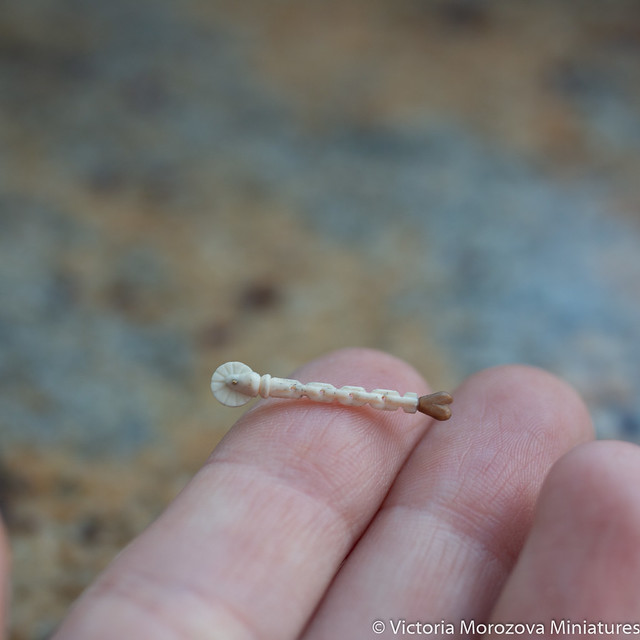
Обещанная вторая часть про гильдийскую школу. В первой я уже показывала весы, а во втором классе Билла мы делали pie crimpers. В каталоге этот класс был заявлен как металлообработка (кхе-кхе, которой там и не было вовсе), а на самом деле, это была резьба по кости. Наш преподаватель – очень щедрый человек, привез нам настоящую слоновую кость, кость мамонта. Я думала сначала, что нам это все просто покажут и уберут, но нет, на самом деле использовали эти материалы.
Это, пожалуй, самый творческий класс, где нет особых правил -выбирай предмет, который тебе больше нравится. Выбирай любой размер, ибо эти колесики на ручке были самых разных размеров. В общем, полная свобода действий. Я выбрала следующее – ручка в виде цепи, на конце которой есть сердце.Ну и стандартное маленькое колесо. Сразу покажу, что в итоге получилось.
Школа IGMA 2018. Часть первая.
Наверное, этот пост будет в первую очередь для русскоязычных читателей, так как про гильдийскую школу у нас знают мало, да и из нашей страны туда еще никто и не ездил. Моя история началась еще в прошлом году, когда мне посчастливилось участвовать в шоу Miniature Masterworks в Канзас Сити. Отбор был конкурсный, несколько человек на место, и мне тогда повезло. На шоу я познакомилась с нереальным количеством людей, которые обожают миниатюру, коллекционируют ее или изготавливают, и это, скажу я вам, дорогого стоит – побыть в компании таких же сумашедших фанатов, как и ты сам. Можно сутками обсуждать всякие технические и около- вещи, и никто не устанет от этого, как твои близкие или друзья. Ну и само шоу захватывает и еще несколько недель не отпускает тебя, приезжаешь домой в эйфории, вдохновленным, хочется горы свернуть.
Так о чем я, на этом шоу я познакомилась со множеством людей из гильдии, IGMA, который наперебой мне стали предлагать, например, поехать в школу поучиться ( а там уж и преподавать предложили – хотя нужного статуса артизана у меня нет, конечно), потом еще артизана неплохо бы получить говорили, попробовать получить стипендию от школы, чтобы поехать туда практически бесплатно (ну это условно, за билеты и прочие бытовые вещи вы платите, плюс вам оплачивается лишь определенное количество часов, а есть еще деньги за материал на уроках, за который тоже нужно преподавателю отдельно платить). От всех этих предложений я отмахивалась как могла, так как школа – это дорого и вообще, а стипендия – это ж надо заявления всякие писать, лень мне было. Об этом я постоянно и говорила, мол, я лучше с ребенком на море съезжу, какая там школа.
Но, видимо, отвертеться было нельзя. В последний день шоу я узнала, что гильдия дает мне специальный грант, который выдается в особых случаях – это довольно длинная история, которую не хочется пересказывать, дабы не соврать в деталях. Тут уж стало понятно, что ехать надо 🙂 Мне выдали книжку с выбором классов, где нужно было выбрать то, что мне было по душе. Можно делать по три выбора на класс, а там уже все решается лотереей. Мне повезло, я попала оба раза на свой первый выбор – классы Билла Робертсона. Про него, наверное, не нужно говорить – один из лучших, если не лучший мастер миниатюры в мире. Первый класс – весы, второй его класс – pie crimper из кости (это такая роликовая штука, чтобы делать фигурные края у пирогов)
Также мне нужно было для школы, в качестве пожертвования на ее нужды, сделать какой-нибудь предмет. В школе, в течение недели проходят несколько аукционов, один с тайным голосованием – вы просто пишете свою цену на лот и опускаете бумажку в урну, а на следующий день узнаете результаты. Второй открытый – вы также пишете свою ставку в общем списке, но видите, как проголосовали другие участники. На этих аукционах выставляют небольшие/недорогие предметы, кто-то распродает старые киты, кто-то старый инструмент, много чего было. Мне удалось выиграть резак для шпона, большой тяжелый с двумя лезвиями и несколькими транспортирами. Вещь необязательная в хозяйстве, но довольно интересная.
Еще один аукцион – классический, с ведущими (один из них был как раз Билл), открытыми ставками и ажиотажем. На нем как раз собирается основная сумма денег, которая пойдет на гранты и стипендии студентам в следующем году, а также на разные нужды школы, как я уже писала выше.
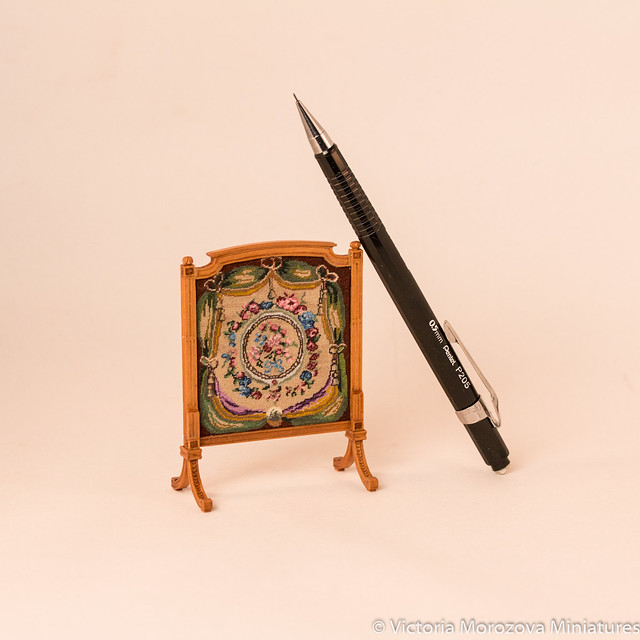
Вот для этого аукциона я и делала экран. Было чувство, что раз мне сделали такой особенный подарок от гильдии, то и я должна сделать что-то особенное. И этот предмет действительно для меня был своеобразным испытанием и расширением горизонтов.
DH magazine publication
I’m very excited and honored to be featured in Dollhouse Miniatures Magazine! Actually it’s my Studley workbench that’s been featured but I’m happy anyway:)
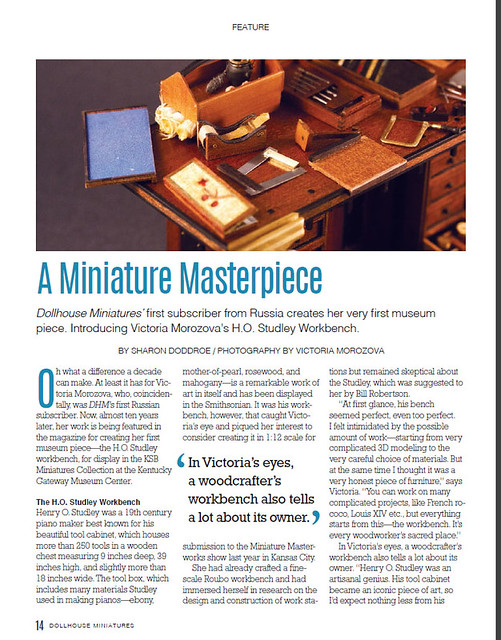
You can buy digital version or print here – 63th issue – http://www.dhminiatures.com/issues
Dollhouse bricks. Almost real!
There are some things that truly inspire. They can make you create a whole room just for them. And recently I found one in Russian social site. In one of the groups I saw a post about miniature bricks with lots of photos, and I was blown away. It’s hard to find an artisan in Russia who creates such complicated things (I’m speaking about technology and process involved) from scratch.
I loved the bricks and instantly wanted to buy them though I had no idea how I could use them, besides I’m making furniture mostly, not roomboxes (sigh). Minutes later I decided to make some sort of decoration for one of my items for Christmas Kensington Festival. I ordered 2kg of bricks.
Dmitry, an artisan who makes these bricks, was also very kind, he sent me bricks of another scale too (1/9) and half-bricks. Look how cool they are:

Lots of photos below:
Miniature Collector
Surprise, surprise! The roombox in the latest issue of Miniature Collector:
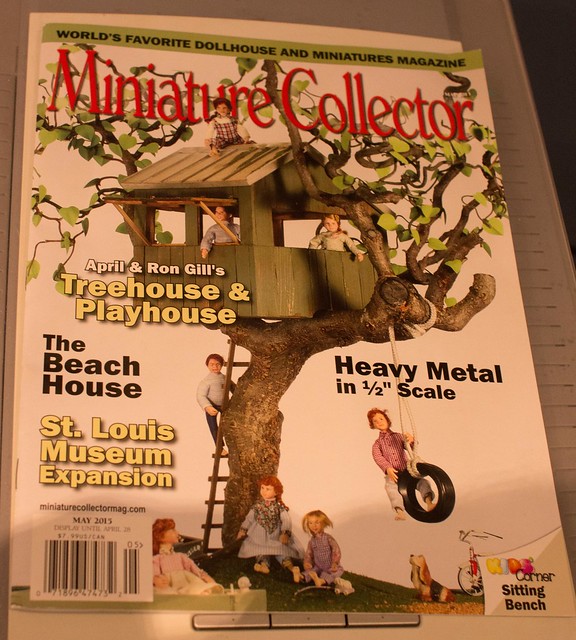
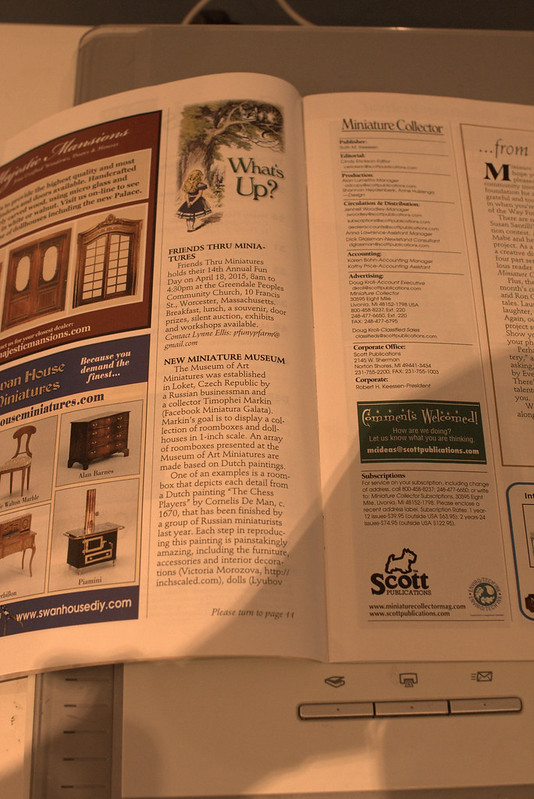
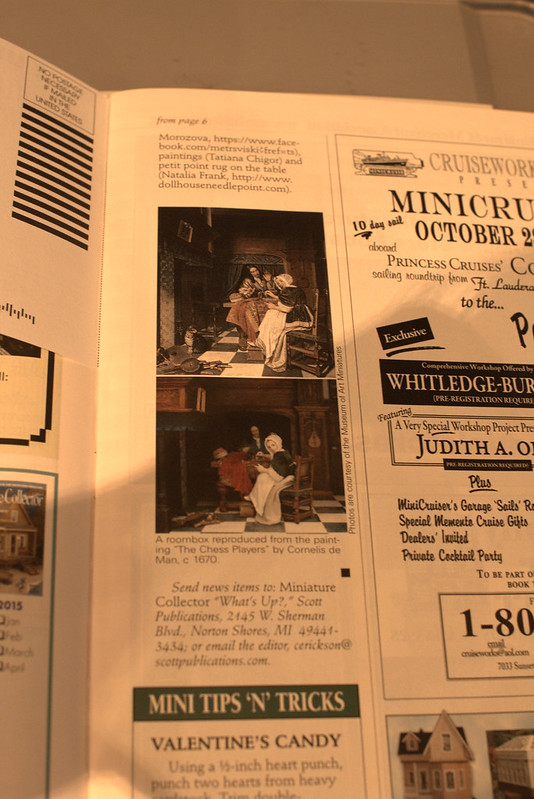
Third publication, first in US. As for me, I’m still sort of struggling with my marquetry project, I’m on Hinges stage right now, but the progress is slow due to real life things. ((
Furniture books
I just love pinterest! Among all those boards on antique furniture – sometimes there are real treasures. This time I found some good recommendations on books about furniture history. Books are shipped, but before this wonderful discovery I bought some really good books too.
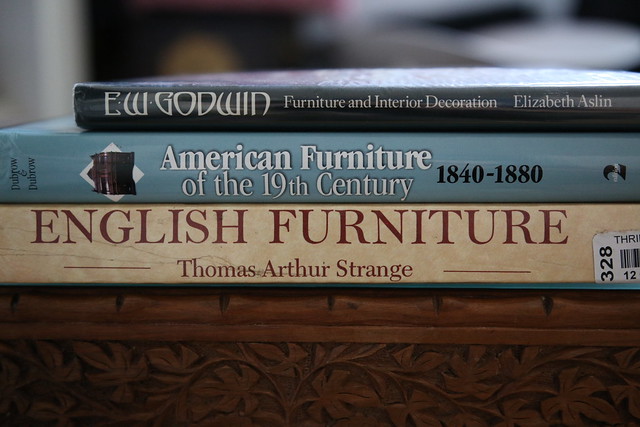
New books.
I got some new books from Ebay last weekend. These are treasures indeed.
Yay!
I don’t even know where to start, yesterday my husband brought the new issue of Miniaturas Magazine, and look who’s there! 🙂 Me! 🙂
This is the process of making Dickens’ desk I made some time ago.
Turning pages and here’s another one! Small article about me and some photos of my furniture and art nouveau roombox.
Still cannot believe my eyes, very happy and humbled. Thank you, Madelva and thank you all for reading my blog! 🙂 Good weekend to you, guys!
Dollshouse and Miniature Scene
Just received the last issue of Dollshouse and Miniature Scene. I always wanted to find a magazine to subscribe, I have several digital subscriptions but needed something offline.
I got tired from the articles in American Miniaturist and Dollshouse World. They repeat the same articles in different mags, so you always have this feeling that you’ve seen it somewhere before. The last straw was repeating the articles about Ferd Sobol’s furniture in Dollshouse World, originally it was published in American Miniaturist (nothing personal here, I’m a huge fan of Sobol’s work:)).
I started thinking about subscribing to Miniature Collector, but there was one problem – our Russian Post. I have five subscriptions to different woodworking magazines and some of them are still somewhere on post. Somehow I’ve never had such problem with packages from UK so I decided on British magazine.
Раз уж зашел разговор про журналы о миниатюре, сегодня будет еще одна история.
Я как-то рассказывала про самые популярные журналы по миниатюре, на которые стоит подписаться. В конце статьи я упомянула английский журнал Dollshouse and Miniature Scene. В интернете его не найдешь, что объясняется достаточно просто — подписка достаточно дорогая и нет электронной версии журнала.
Наступил как-то момент, когда те журналы, на которые у меня была подписка мне наскучили, я читаю American Miniaturist и Dollshouse World. Может, я повторюсь, но у них одно издательство, а, значит, они, издатели, почему-то решили, что можно повторять статьи. Ведь один журнал вроде ориентирован на американцев, есть еще из этого же издательства журнал Dollhouse Miniatures (тоже американский), а второй ориентирован на англичан. То есть, якобы американец никогда не будет выписывать английский журнал и наоборот. Ну а я из России, про такой нюанс при подписке ничего и не знала. С тех пор, вот уже два года при просмотре нового номера меня довольно часто посещает чувство, что я уже где-то это видела. Статьи повторяются один в один, там даже фон и фотографии те же. Согласитесь, за свои кровные хочется чего-то нового, хочется новой информации. Особенно добила меня серия статей про мебель Ферда Соболя, она была где-то год назад в American Miniaturist, а теперь меня заставляют заново все это повторять в Dollshouse World. В общем, при всей моей любви к этому мастеру, как-то неприятно.
Решила я тогда найти журнал, который точно не из этого издательства халтурщиков, а что-то более стоящее. В США это журнал Miniature Collector. Тут был один минус – из США все едет долго (до сих пор мои журналы по деревообработке едут, уже который месяц, фиг отследишь). Кроме того, знающие люди, живущие в США, мне рассказали, что по сути там одна реклама миниатюристов, я также посмотрела на некоторые статьи и поняла, что рекламу я и в интернете в фейсбуке, например, получаю.
Англия оказалась ближе, доставка всегда хорошая (т-т-т), и есть такой вот журнал – Dollshouse and Miniature Scene. Выходит он раз в месяц, в пакете я получила набор для “сборки” плюшевого медведя. Собирать его я не стала, отложила до лучших времен, а вот внутри журнал оказался достаточно интересным.